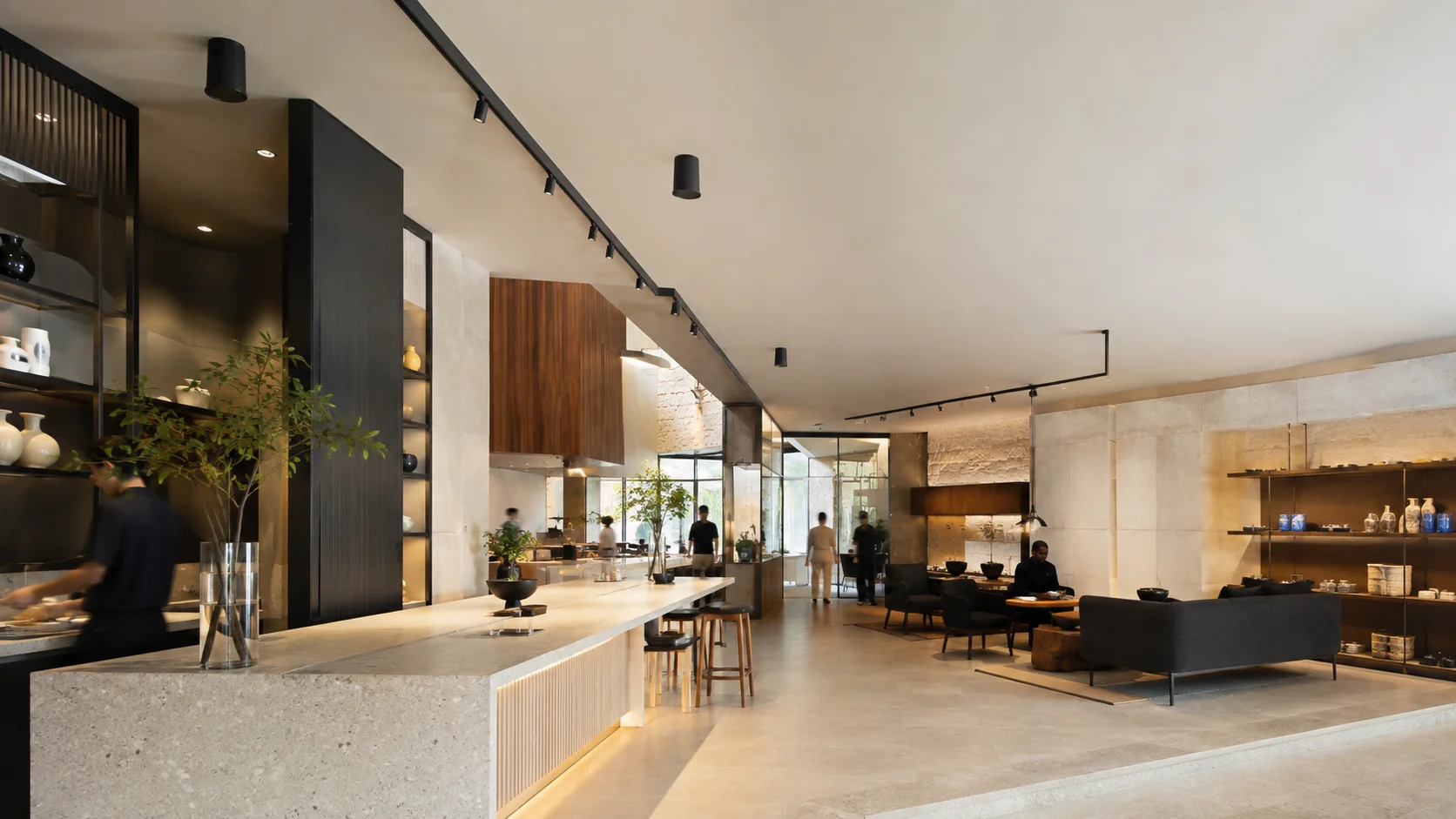
The goal: not simply louder sound, but a consistent, comfortable experience wherever customers, guests and staff move.
Commercial audio is part of the environment
In a shop, restaurant, hotel or office, sound is rarely the main event. Yet it changes how the space feels. The right system can create energy, support a brand atmosphere and keep announcements intelligible. The wrong one draws attention for all the wrong reasons: one table is overwhelmed, another hears very little, and staff compensate by turning the volume up.
That is why professional audio design begins with coverage rather than wattage. It is not about how powerful one loudspeaker is, but how evenly useful sound reaches the occupied area at an appropriate level.
The short answer
A 360° loudspeaker is designed to distribute sound around the source in the horizontal plane. Used with appropriate spacing and mounting height, this wide dispersion can help create a more continuous sound field – often described as a sound carpet – instead of a series of obvious loud and quiet pockets.
The 360° coverage in our speakers are thanks to a protected aluminium-membrane principle.
 Figure 2. Coverage concept. Wide dispersion can make consistency easier to achieve, but this is not a measured prediction for a specific product or room.
What 360° does – and does not – tell you
It describes direction, not guaranteed level
The 360° description is about horizontal radiation around the loudspeaker. It does not mean the sound level is identical at every seat, that every frequency behaves exactly the same, or that the room has no effect. Reflections, absorption, ceiling height, obstructions and background noise all influence the listener’s experience.
It can reduce visible aiming
A conventional directional loudspeaker is useful when sound must be focused at a defined audience or kept away from reflective surfaces. A wide-dispersion design can be valuable when listeners surround the source or move freely through the space. Neither approach is universally superior; each solves a different geometry problem.
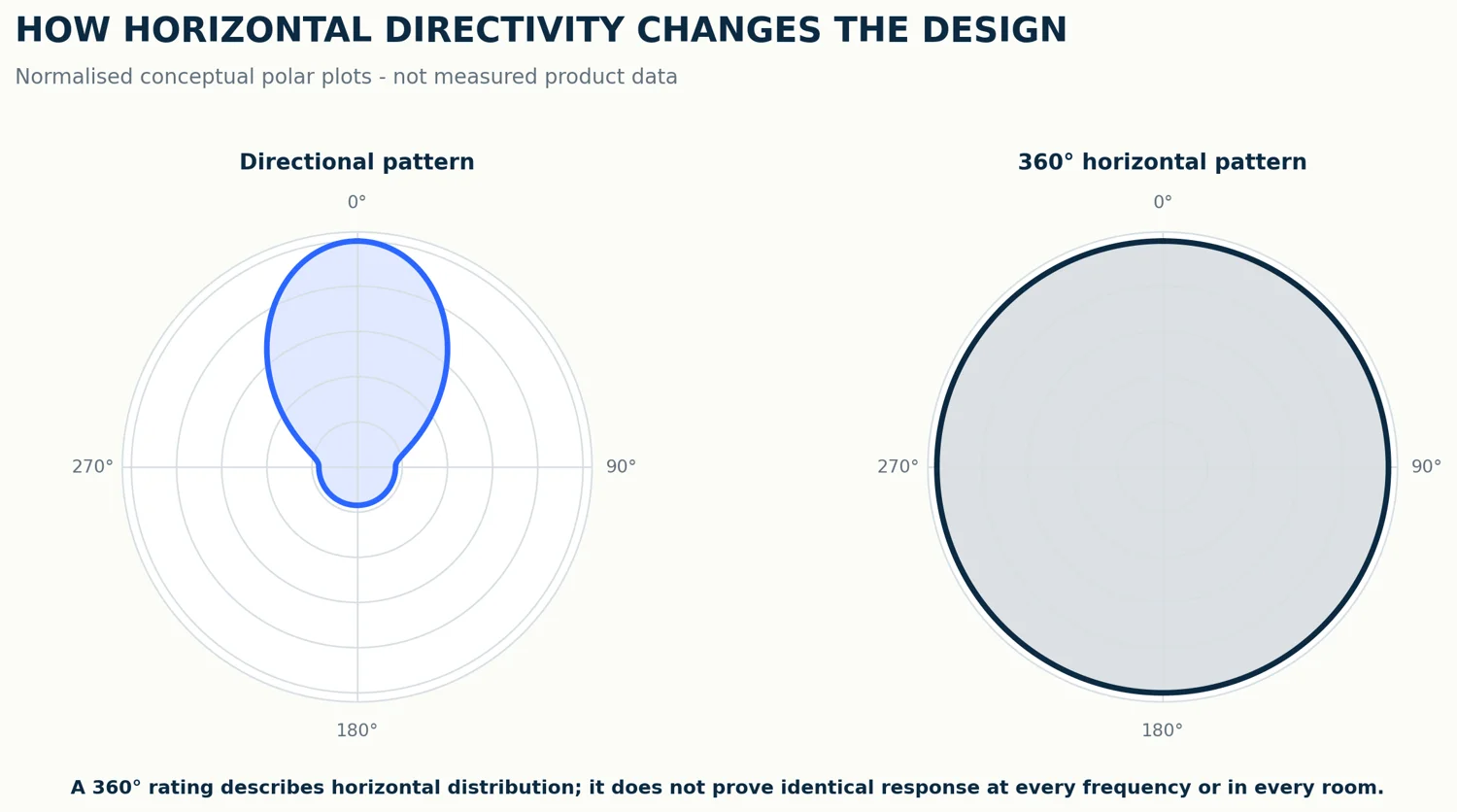 Figure 3. Conceptual horizontal directivity. Final selection should use the manufacturer’s measured polar data for the relevant model and frequency bands.
The loudspeaker is only one part of the solution
Commercial audio should be provided as a complete system: loudspeaker design, installation options, project planning, technical support, partner training, local control and cloud-based management. That is the right way to think about the specification. A visually elegant loudspeaker can still disappoint if the zones, sources, access rights and operating workflow are not planned.
A product family built around the architecture
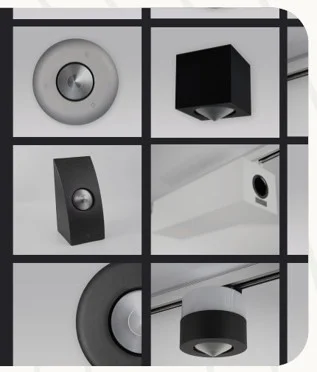 Figure 4: Multiple form factors for different architectural and installation conditions.
Source image: NewTec 2025 Haendler Brochure.
Four questions to answer before choosing a model
- Where is the listening plane?
Ceiling height and listener distance influence coverage, level and speaker spacing. - What must the system reproduce?
Background music, announcements and foreground audio place different demands on bandwidth and intelligibility. - How visible may the equipment be?
Ceiling, pendant, wall, surface and lighting-track options change both aesthetics and coverage geometry. - How will the venue operate it?
Daily staff control should be simple, while commissioning and remote support need appropriate technical access.
Wired, wireless and cloud-controlled are different decisions
Wireless audio is often described as if it removes infrastructure altogether. It does not. Loudspeakers and system components still require power, suitable mounting and a carefully designed signal path. The benefit is that wireless distribution can reduce or avoid dedicated audio cabling in suitable projects, making refits and changing layouts easier.
Our SMART Audio solution uses DECT for the wireless link and our app for local system control. The Cloud adds remote access, monitoring and support functions. The right architecture depends on the number of rooms, sources and zones, along with network, security and operational requirements.
 Figure 5. A conceptual multi-zone operating model. Exact components and network topology depend on the selected system and project scope.
Design note: Cloud access should be planned with named users, minimum necessary permissions, secure account practices and a clear handover process.
Why remote management matters
Remote control is not only a convenience for changing the volume. In a multi-site or multi-floor environment, it can support faster fault finding, consistent settings, controlled updates and expert assistance without every intervention requiring a site visit.
The Cloud provides three practical benefits:
- Remote access from different devices
- Live system adjustments
- Remote maintenance or support.
These functions are most useful when they are built into a documented operating model – not added after commissioning as an unused extra.
Remote control at a glance
 Figure 6.
Source: NewTec 2025 Haendler Brochure.
Where the approach fits
The design priority changes from one space to another.
| Environment | Experience priority | Design question | Useful control approach |
| Retail | Consistent brand atmosphere | Can customers hear the same balanced programme while moving? | Zones by floor, department or trading area |
| Gastronomy | Comfortable conversation | Can levels differ between dining, bar and terrace areas? | Daypart presets and independent zone levels |
| Shopping centre | Continuity across large circulation paths | How will level and delay remain coherent over distance? | Area groups with central oversight |
| Office | Low-fatigue background sound and clear messaging | Where must sound support focus without distracting teams? | Time schedules and room-by-room control |
| Hotel | Different moods across guest spaces | How will lobby, lounge, spa and restaurant needs stay separate? | Scene-based presets with role-based access |
A sensible project process
- Define the experience. Decide whether the system is for subtle ambience, energetic foreground music, speech or a combination.
- Map occupied areas and movement. Mark seating, circulation, service counters, quiet zones, terraces and areas with different hours.
- Review the architecture. Record ceiling heights, mounting options, reflective surfaces, partitions, lighting tracks, power and network access.
- Model coverage and zones. Select loudspeaker types and spacing from measured data, then plan source routing and independent level control.
- Install and commission. Verify polarity, gain structure, equalisation, zone balance, source quality and speech intelligibility on site.
- Train and hand over. Give daily users a simple control path, document technical access and agree how remote support will be authorised.
Common specification mistakes
- Treating 360° as proof of uniform sound without checking measured directivity and the room geometry.
- Choosing by wattage or product count before defining the target level and coverage area.
- Assuming wireless means cable-free, power-free or automatically reliable in every building.
- Creating too few zones, leaving staff to compromise between quiet and active areas.
- Giving every user full cloud access instead of separating daily operation from technical administration.
- Skipping commissioning because the system produces sound when it is switched on.
Frequently asked questions
Is a 360° loudspeaker the same as an omnidirectional loudspeaker?
In everyday commercial language the terms are often used similarly, but the useful answer comes from the measured polar response. Check how the selected model behaves in the horizontal and vertical planes, and across frequency.
Will wide dispersion always mean fewer speakers?
Not always. NewTec states that its approach can reduce speaker count in suitable projects, but the actual quantity depends on ceiling height, target level, room shape, obstructions and performance requirements.
Is DECT the same as Wi-Fi audio?
No. DECT is a separate wireless technology. NewTec describes DECT as the transport used by its SMART Audio solution; the control and cloud layers have their own connectivity requirements.
Can different areas play different content?
That depends on the source and system configuration. Multi-zone designs can provide independent levels and, where the architecture supports it, different sources or schedules for different areas.
Does cloud control replace on-site commissioning?
No. Remote tools can support operation and maintenance, but loudspeaker placement, level balance, equalisation and intelligibility must still be verified in the physical space.
Design the experience, then choose the technology
The most valuable idea in NewTec’s 2025 brochure is not a single product feature. It is the view that sound quality comes from a complete, supported solution: consistent coverage, appropriate form factors, manageable installation, sensible control and a plan for ongoing support.
The commercial result
For commercial spaces, this is the difference between a collection of loudspeakers and an audio environment. When the system is designed around people, movement and daily operations, the technology can fade into the architecture while the experience remains clear, comfortable and on brand.
Planning a retail, hospitality, office or hotel project? Speak to LED Lighting SA about an integrated lighting, automation and audio & visual solution designed around your space.
Editorial acknowledgement: This independent LED Lighting SA article was informed by material supplied by NewTec Design:Audio. Brochure images are reproduced for reference with credit to NewTec. Conceptual graphs and diagrams were created for this guide and are not measured product data.