An LED luminaire does not normally reach a particular hour, switch off and become unusable overnight.
More often, its light output changes gradually. After thousands of operating hours, the fitting may still be working but may produce less light than it did when new. At the same time, a driver or another critical component can fail abruptly and cause the luminaire to stop producing light altogether.
These are different failure mechanisms, and a lifetime statement such as 50,000 hours L80B10 describes only one part of the picture.
Understanding LxBy notation helps lighting designers, engineers, facilities teams and customers compare products more intelligently. It also prevents a projected lumen-maintenance value from being mistaken for a warranty, a guaranteed replacement date or a complete measure of luminaire reliability.
Read the complete declaration: operating hours + L threshold + B population basis + separate abrupt-failure information.
LED lifetime is not a single expiry date
The word lifetime can be misleading when it appears on an LED data sheet.
For a conventional lamp, end of life was often associated with the lamp no longer operating. LED systems behave differently. Their useful performance can be limited by:
- Gradual depreciation of light output
- Abrupt failure of the driver, LED module or another critical component
- Colour shift or reduced colour consistency
- Degradation of lenses, diffusers, seals or other optical materials
- Dirt accumulation and the maintenance conditions of the installation
- A change in the application requirement before the product itself reaches end of life
LxBy deals primarily with gradual luminous-flux depreciation in a population of products that are still operating. It does not, by itself, tell us how many complete luminaires or drivers may have failed.
That distinction is the starting point for reading the rating correctly.
How to read LxBy
The notation combines a lumen-maintenance threshold, a population percentile and a stated number of operating hours.
- L stands for lumen maintenance.
- x is the percentage of initial luminous flux that must be maintained.
- B refers to the portion of the operating product population that may fall below the L threshold by the stated time.
- y is that percentage of the population.
The operating time is essential. L80B10 is incomplete unless the declaration also states when the result is expected, such as 50,000 or 100,000 hours.
Example: 50,000 hours L80B10
This means that at 50,000 operating hours, no more than 10% of the luminaires that are still operating are projected to produce less than 80% of their initial luminous flux.
Expressed from the other direction, at least 90% of the operating population is projected to maintain 80% or more of its initial output at that time.
It does not mean:
- Every fitting will produce exactly 80% at 50,000 hours
- 10% of the fittings will be completely dead
- The product will suddenly fail at 50,001 hours
- The fitting is guaranteed or warranted for 50,000 hours
- The complete installation will still deliver 80% of its original lux
The last point matters because maintained illuminance in a real space is also affected by dirt, surface changes, optics, room conditions, aiming and the maintenance plan.
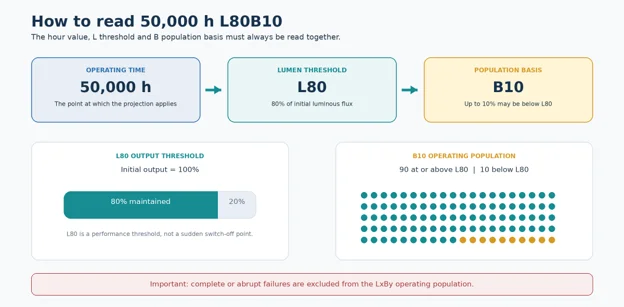 Figure 2. A 50,000-hour L80B10 declaration combines an operating time, an 80% lumen-maintenance threshold and a 10% operating-population percentile.
L90, L80 and L70: the maintained-output threshold
The L value describes the lumen-maintenance level used to define useful life.
L90
The product is assessed against a threshold of 90% of its initial luminous flux. Only 10% depreciation is allowed at the declared time.
L90 can be valuable where maintained performance is critical, where the lighting operates for long hours, where access is difficult or where the design has limited tolerance for declining output.
L80
The product is assessed against a threshold of 80% of its initial luminous flux. This is a common professional-lighting reference because it balances maintained performance with a realistic service horizon.
Its suitability still depends on the application, operating hours, ambient conditions and maintenance strategy.
L70
The product is assessed against a threshold of 70% of its initial luminous flux.
L70 has historically been used as a general LED lifetime convention, but it is not automatically the correct end-of-life point for every project. A 30% reduction may be unacceptable in a production area, retail environment, transport application or tightly engineered lighting design even though the fitting remains operational.
The right L value is therefore determined by the maintained lighting requirement, not by whichever number creates the longest headline lifetime.
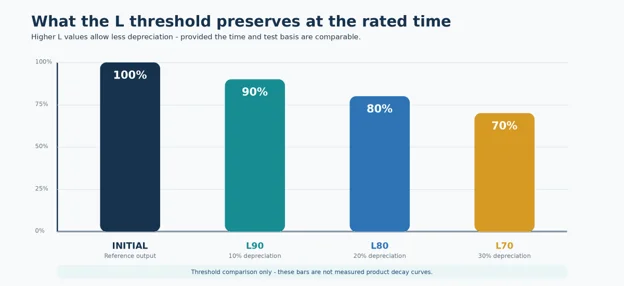 Figure 3. L90, L80 and L70 preserve 90%, 80% and 70% of initial luminous flux at the relevant rated time. This is a threshold comparison, not a measured decay curve.
B10 and B50: understanding the population
The B value is frequently described as an allowance for variation across a group of products.
B10
At the stated time, up to 10% of the operating population may be below the L threshold. The remaining 90% is projected to be at or above it.
For example, 50,000 hours L90B10 indicates that at least 90% of the operating population is projected to maintain 90% or more of its initial output at 50,000 hours.
B50
At the stated time, 50% of the operating population may be below the L threshold and 50% may be at or above it. This is the median useful life.
Under IEC terminology, median useful life is commonly written simply as Lx, with B50 understood. A declaration such as L80 at 50,000 hours may therefore represent L80B50, provided the manufacturer states the basis clearly.
Is B10 automatically better than B50?
Not necessarily.
B10 sounds stricter because it describes a smaller portion of the population falling below the threshold. However, current LightingEurope guidance adds an important qualification: IEC 62722-2-1 defines By, but does not provide a complete method for verifying or applying every By value in lighting design.
LightingEurope’s 2025 analysis found that, for the manufacturer data it reviewed at projections up to 100,000 hours, the difference in lumen depreciation between B10 and B50 was about one percentage point. It therefore recommends using the standardised median value, expressed as Lx, for more consistent product comparison.
The practical lesson is not that B10 has no meaning. It is that a B10 claim should not be treated as proof of superior quality without understanding the calculation method, test basis and complete luminaire data behind it.
Compare the full declaration, not isolated numbers
These three statements do not describe the same performance:
- 50,000 hours L90B10
- 60,000 hours L80B10
- 90,000 hours L70B50
The threshold, population percentile and operating time all change.
It is therefore misleading to compare only the largest hour value. A fitting rated L70 at 100,000 hours may deliver less maintained output at the project’s planned replacement date than a fitting rated L90 at 75,000 hours.
A fair comparison should use:
- The same operating-hour horizon
- The same L threshold or the maintained output at the chosen horizon
- A clearly stated B basis
- The same rated ambient temperature
- Complete-luminaire data rather than LED-package data alone
- Comparable driver and abrupt-failure information
- The same assumptions for switching cycles, drive current and operating conditions
For like-for-like comparison, LightingEurope recommends evaluating the maintained lumen percentage at common time points such as 35,000, 50,000, 75,000 or 100,000 hours, selected according to the intended application.
Gradual depreciation and abrupt failure are different
An LxBy declaration includes operating luminaires. Products that have stopped operating are excluded from that population.
This means a fitting can have an impressive L90 declaration while the reliability of its driver, connections, seals or protection components still determines whether the complete luminaire remains operational.
Gradual luminous-flux depreciation
The fitting continues producing light, but the output has reduced over time. LxBy is used to describe this parametric change.
Abrupt failure
The luminaire stops producing light because a critical component or the system has failed. This must be considered separately through an abrupt-failure value, time-to-abrupt-failure information, control-gear failure rate or other credible system-reliability data.
The complete lifetime picture therefore needs both:
- Maintained light output: How much light will operating luminaires continue to produce?
- System survival: How many complete luminaires are expected to remain operational?
For applications where continuity is critical, redundancy, serviceability, replaceable control gear, surge protection and a clear maintenance response can matter as much as the L value.
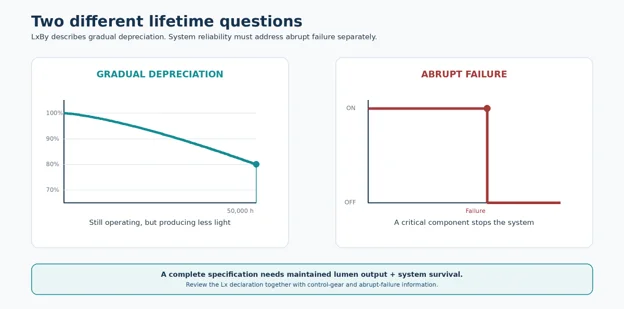 Figure 4. LxBy describes gradual light-output depreciation among operating luminaires; abrupt system failure is a separate reliability question.
How LED lumen maintenance is assessed
Very long lifetime claims cannot normally be confirmed by waiting for every luminaire to operate for 50,000 or 100,000 hours before it is released.
Instead, manufacturers use controlled measurements, component data, thermal information and projection methods.
LM-80 measures LED light-source maintenance
ANSI/IES LM-80-21 defines methods for measuring lumen and colour maintenance of LED packages, arrays and modules under controlled conditions.
It provides valuable source-level data, but an LM-80 report is not a complete-luminaire lifetime result. The LED source may operate at a different temperature and drive current once it is installed inside a fitting.
TM-21 projects long-term source behaviour
ANSI/IES TM-21-21 provides a method for projecting long-term flux maintenance from LM-80 data. It includes limits on extrapolation because a mathematical projection becomes less certain as it extends beyond the measured test period.
IEC standards address modules and luminaires
IEC 62717 covers LED-module performance requirements, while IEC 62722-2-1:2023 covers performance requirements for complete LED luminaires. IEC 63013 provides procedures for projecting the long-term luminous-flux maintenance of LED packages.
The key purchasing question is therefore: Does the declaration describe the LED package, the LED module or the complete luminaire under its actual operating conditions?
Package data alone cannot account for the complete thermal path, driver, housing, optics, seals, wiring, environmental protection and installation conditions.
Why thermal management matters
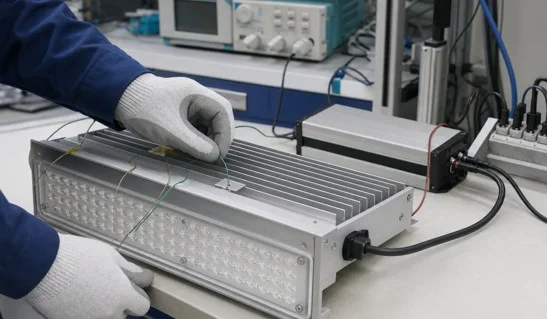 Figure 5. Full-luminaire thermal and electrical evaluation helps connect component data to real operating conditions.
Heat is one of the most important influences on LED lumen maintenance and system reliability.
Although LEDs are efficient, not all input power becomes visible light. Heat must travel from the LED junction through the board, interface materials, housing and heat sink before it can dissipate into the surrounding air.
If this thermal path is poorly designed or the ambient temperature is higher than assumed:
- LED junction temperature can rise
- Lumen depreciation can accelerate
- Colour can shift
- Driver and component stress can increase
- Seals, plastics and optical materials can age faster
- The projected performance may no longer reflect the real installation
This is why lifetime data should be linked to the rated ambient performance temperature, often shown as tq, and why full-luminaire thermal validation is more meaningful than a headline value inherited from the LED package.
In South African projects, high ambient temperatures, solar exposure, dust, coastal contamination, unstable supply conditions and long operating schedules can make product engineering and environmental suitability especially important.
Other factors that influence useful performance
Drive current
Driving an LED harder can produce more initial light from fewer components, but it normally increases electrical and thermal stress. A balanced design may operate LEDs more conservatively to support long-term performance.
Driver and control gear
Electrolytic capacitors, switching components, connectors and protection devices can determine system survival. Driver quality, thermal position, surge protection and replaceability deserve separate consideration.
Optical materials
Lenses, diffusers, reflectors and seals may yellow, haze, crack or collect contaminants. An LxBy statement based on the LED source may not fully represent these optical losses.
Environment
Temperature, humidity, dust, chemicals, vibration, salt, water ingress and voltage disturbances can change the real-world outcome. The product’s ingress protection, material selection, surge protection and application suitability must match the site.
Switching and controls
Switching cycles, dimming levels, occupancy controls and operating schedules affect the duty profile. Dimming can reduce energy use and thermal stress, while unsuitable switching or control conditions can place additional stress on control gear.
Maintenance
Even a luminaire with excellent internal lumen maintenance can deliver declining lux when dirt builds up or room surfaces change. The lighting design should use a maintenance factor and a realistic cleaning or replacement plan.
What 50,000 hours means in calendar years
Rated hours are operating hours, not elapsed calendar time.
Approximate conversions illustrate why the same declaration can represent very different service periods:
- At 2,000 hours per year, 50,000 hours is about 25 years
- At 4,380 hours per year, 50,000 hours is about 11.4 years
- At 5,840 hours per year, 50,000 hours is about 8.6 years
- In continuous 24/7 operation, 50,000 hours is about 5.7 years
The calculation is simply rated operating hours divided by annual operating hours. It does not extend the warranty or guarantee that the environmental and electrical conditions will remain unchanged.
It also explains why the longest possible rating is not always the best purchasing criterion. Many interiors are refurbished before an extremely long projected life is reached, while high-access industrial, roadway, rail or infrastructure installations may genuinely benefit from a longer maintained-performance horizon.
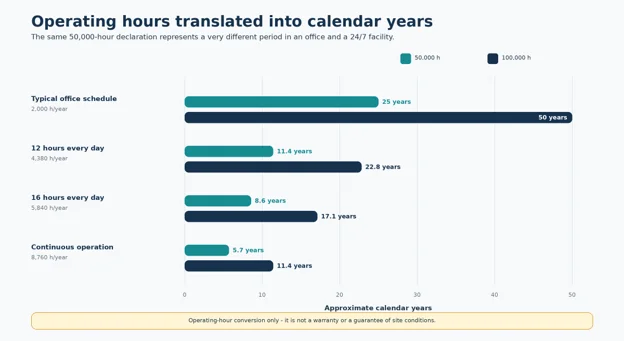 Figure 6. Operating-hour conversions for 50,000- and 100,000-hour declarations across four example schedules. These calculations are not warranty periods.
A practical application guide
| Application profile | Lifetime focus | Also verify |
| Offices, schools and general interiors | Maintained output at the planned refurbishment horizon | Glare, flicker, colour quality, controls, cleaning, driver reliability and warranty |
| Retail and hospitality | L80 or L90 where appearance and designed contrast must be protected | Colour quality, optical ageing, dimming, aiming, heat around displays and refurbishment cycle |
| Warehouses and factories | Strong maintained output over long hours, especially at high mounting heights | Ambient temperature, dust, vibration, surge protection, driver access and maintenance cost |
| Healthcare and other extended-hour facilities | Maintained performance plus low abrupt-failure risk | Redundancy, emergency lighting, controls, serviceability and operational continuity |
| Roads, tunnels and outdoor infrastructure | Performance at the design horizon, often 75,000 or 100,000 hours where justified | Rated ambient temperature, ingress protection, corrosion, surge protection, driver failure rate and cleaning |
| Rail, transport and specialist systems | Project-specific maintained output and system reliability | Vibration, thermal cycling, electrical conditions, redundancy, compliance testing and maintainability |
These are decision factors, not universal minimum ratings. The correct declaration depends on the visual task, risk, access cost, operating schedule, maintenance strategy and governing project requirements.
A better way to compare LED lifetime data
1. Fix the project time horizon
Estimate the annual operating hours and intended refurbishment or replacement date. Compare products at a time point that matters to the project.
2. Compare maintained output at the same time
Ask what percentage of initial lumens is projected to remain at 50,000, 75,000 or 100,000 hours rather than comparing unrelated L values and hour claims.
3. Confirm the population basis
Check whether the declaration uses median useful life, B10 or another By value, and ask how any non-median claim was derived.
4. Confirm the temperature and drive conditions
The declared ambient temperature, LED operating temperature and drive current should be relevant to the actual luminaire and site.
5. Separate source data from luminaire data
Do not assume an LED-package projection is the lifetime of the complete fitting. Request complete-luminaire performance and thermal evidence where the project risk justifies it.
6. Ask about abrupt failure
Review the expected control-gear failure rate, system-reliability information, warranty, replaceable components and maintenance response.
7. Include the lighting maintenance factor
Lumen maintenance is one input to maintained illuminance. The lighting calculation must also consider dirt, cleaning intervals, surface changes and any optical depreciation.
8. Review the complete quality picture
A high lifetime declaration does not prove good optics, low glare, accurate colour, low flicker, energy efficiency, safe operation or suitability for the environment. Lifetime is one part of a complete specification.
Common questions about LxBy ratings
Does L80B10 mean 10% of the luminaires will be dead?
No. It means up to 10% of the operating population may be below 80% of initial luminous flux at the stated time. Complete or abrupt failures are considered separately.
Is L90 always better than L80?
Only in a like-for-like comparison at the same operating time, temperature and population basis. A well-supported L90 declaration indicates stronger lumen maintenance, but the complete product and application still have to be assessed.
Is B10 always better than B50?
It appears stricter, but it is not automatically a more useful or better-verified comparison. Current LightingEurope guidance recommends the median Lx value for consistency and cautions against overemphasising By.
Does 100,000 hours mean the product is guaranteed for 100,000 hours?
No. Long-term lumen maintenance is normally a projection. Warranty duration, terms, operating conditions and covered failure modes are separate commercial commitments.
Can LM-80 data prove the lifetime of a luminaire?
Not by itself. LM-80 measures LED packages, arrays or modules under controlled conditions. Complete-luminaire performance also depends on temperature, drive current, driver reliability, optics, housing and environmental conditions.
When should an LED luminaire be replaced?
Replacement should be based on the project’s maintained-lighting requirement, reliability, energy use, condition, serviceability and maintenance economics. The L threshold is a useful input, not an automatic universal replacement command.
Specify maintained performance, not just a headline lifespan
L90B10, L80B10 and L70B50 are useful only when the whole declaration is understood.
The L value tells us the lumen-maintenance threshold. The B value describes the population percentile among operating products. The hour value tells us the projected operating time. None of these, alone, describes abrupt failures, warranty cover or the maintained lux of the complete installation.
At LED Lighting SA, we approach lifetime as a complete engineering question. LED selection, drive conditions, thermal design, control gear, optics, materials, environmental protection and the intended application all influence how a luminaire performs over time.
Because the goal is not simply to claim the highest number of hours. It is to deliver the required light, at the required quality, for the period that the project genuinely needs.
Speak to the LED Lighting SA team about product selection, thermal and application engineering, photometric design or a project-specific lighting solution for commercial, retail, industrial, transport or specialist environments.
References
- Caribou – What do L/B values L90/B10, L80/B10 and L70/B50 stand for?
- Lena Lighting – LxBy parameters
- LightingEurope – Evaluating performance of LED based luminaires, updated January 2025
- IEC 62717 – LED modules for general lighting: Performance requirements
- IEC 62722-2-1:2023 – Particular performance requirements for LED luminaires
- IEC 63013 consolidated edition – LED package long-term flux maintenance projection
- Illuminating Engineering Society – ANSI/IES LM-80-21
- Illuminating Engineering Society – ANSI/IES TM-21-21