DMX & Architainment
Lighting • Automation • Audio & Visual
Stand-Alone DMX Colour Control
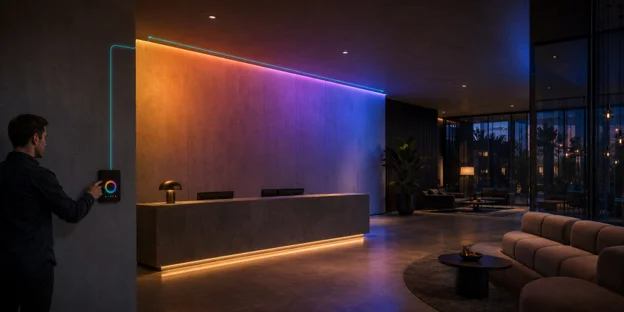
A stand-alone DMX system provides direct, local control of colour-changing luminaires without requiring a permanent computer or Ethernet network. Once programmed, the controller can recall preset colours, dimming levels, fades and simple sequences through a compact wall station or dedicated interface.
Best suited to: Feature walls, reception areas, restaurants, bars, boutique retail displays and small facades.
Key benefits
- Simple local operation with no permanent network or computer required.
- Provides reliable control of RGB or RGBW colour and intensity.
- Preset scenes, fades and simple sequences can be recalled easily.
- Compact architecture with fewer system components.
- Straightforward commissioning and day-to-day operation.
- A cost-effective solution for small or self-contained installations.
Art-Net Networked DMX Systems
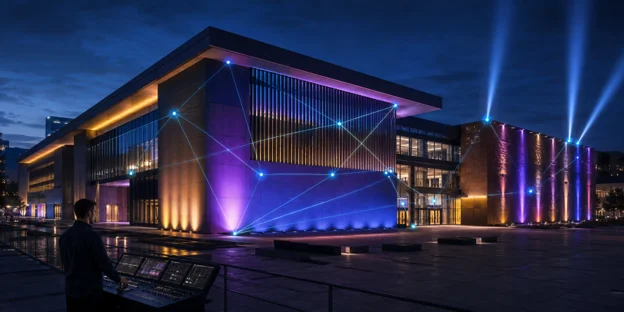
Art-Net transports DMX lighting data over an Ethernet network, allowing multiple DMX universes to be distributed between controllers, gateways and lighting nodes. This makes it possible to coordinate colour-changing luminaires, moving lights and dynamic scenes across large installations from a central control platform.
Best suited to: Large facades, shopping centres, entertainment venues, public spaces, bridges and arenas.
Key benefits
- Carries multiple DMX universes across a single Ethernet infrastructure.
- Scales efficiently across large and multi-zone installations.
- Coordinates colour, intensity, movement and effects from a central platform.
- Distributed nodes reduce long DMX cable runs back to the controller.
- Supports synchronised scenes across buildings, zones and exterior areas.
- Integrates with professional lighting consoles and show-control platforms.
- Allows the system to expand as additional fixtures and control zones are added.
Networked DMX with Addressable SPI Pixels
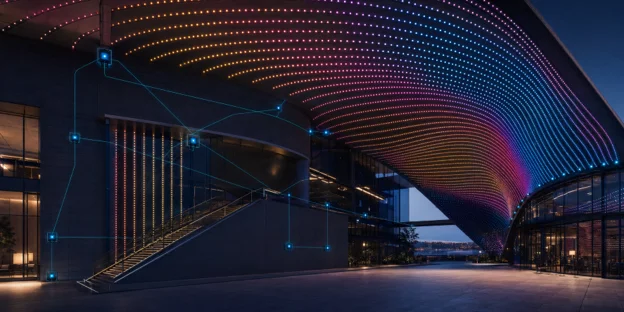
In complex pixel installations, networked DMX data is delivered to dedicated pixel controllers, which translate the data into the SPI or pixel protocol required by the LED product. Each individually addressed pixel can then be controlled independently, enabling detailed gradients, chases, animation and media-style effects.
Best suited to: Landmark facades, public art, immersive spaces, architectural canopies and themed environments.
Key benefits
- Provides individual control of each pixel’s colour and intensity.
- Creates detailed gradients, chases, animation and dynamic patterns.
- Supports pixel mapping across complex shapes and large architectural surfaces.
- Scales to high channel counts through distributed networked controllers.
- Synchronises effects across multiple zones and structures.
- Allows visual content to be updated for events, seasons or campaigns.
- Enables distinctive, immersive and highly customised lighting experiences.